New Zealand's $200 Billion Infrastructure Pipeline Is a Talent Planning Failure — Not a Funding One
Most industries treat a project pipeline as a revenue forecast. New Zealand's infrastructure sector is learning the hard way that a pipeline is only as real as the workforce plan sitting underneath it — and right now, that workforce plan doesn't exist at the scale the numbers demand.
When "Fully Funded" Doesn't Mean "Deliverable"
New Zealand has roughly $200 billion in infrastructure work approved or planned. By any normal measure, that's a healthy demand signal. But senior industry leaders are converging on a different conclusion: money and fast-tracked consents were never the bottleneck. The bottleneck is talent supply, and no amount of capital fixes a labour market that can't produce enough qualified people fast enough.
Tracey Ryan, chief executive of Aurecon New Zealand and chair of Infrastructure New Zealand, has reframed the entire conversation around this point — infrastructure isn't a series of construction jobs to staff reactively, it's a growth strategy that requires workforce planning as rigorous as the engineering itself. That's a talent management problem before it's a construction problem.
The Workforce Data Behind the Warning
The underlying metrics read like a case study in reactive, rather than strategic, workforce planning:
- Construction employment fell 3.5% in the year to March 2025, with the sector shedding around 16,000 jobs over two years — a talent drain happening in parallel with rising project volume.
- New Zealand recorded a net loss of 46,400 citizens in the year to September 2025, with most departures heading to Australia's more stable project pipeline and higher pay. Infrastructure talent is proving to be one of the most mobile — and most poachable — segments of the workforce.
- The sector needs approximately 2,300 new engineers annually and consistently misses that target. Engineering represents a below-OECD-average share of graduates, and a third of those who do qualify leave the profession within two years — a retention failure as much as a pipeline failure.
- About a third of the current engineering workforce trained overseas, meaning the entire system is already structurally dependent on international talent sourcing to function at all.
Infrastructure New Zealand's Nick Leggett has described the resulting cycle plainly: cut or delay a project and the workforce scatters or emigrates; announce a new one and there's no one left to staff it. That's a textbook symptom of workforce planning built around individual projects instead of long-term talent pipelines.
What Poor Workforce Continuity Actually Costs
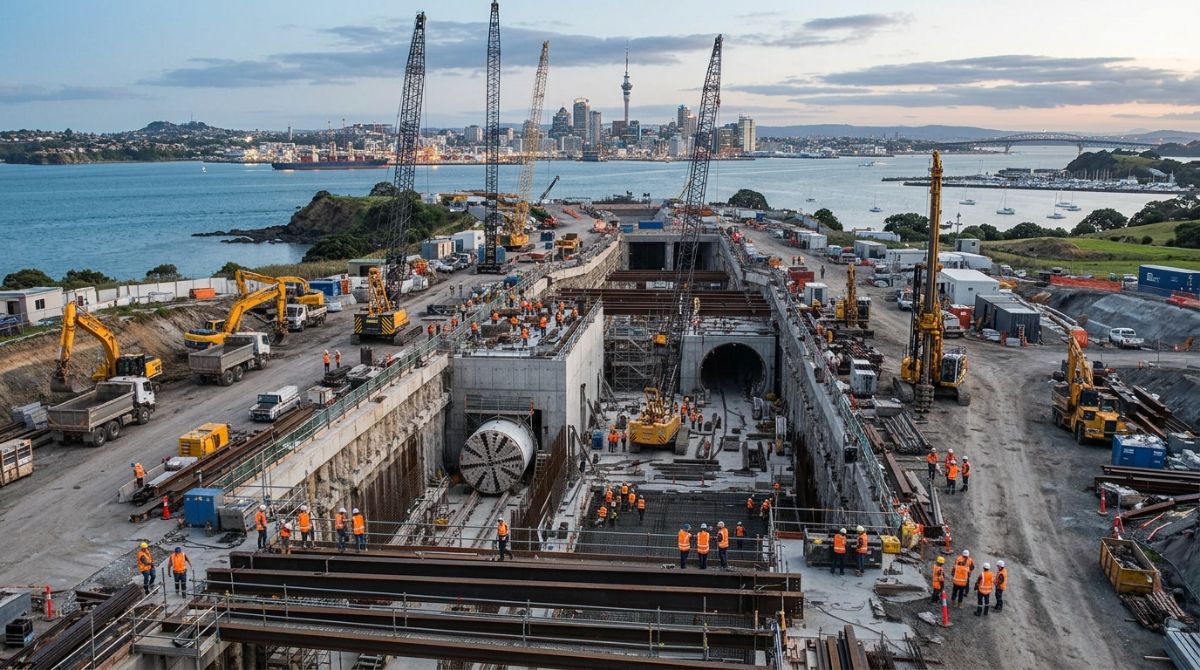
The Auckland City Rail Link is the clearest illustration of this failure mode. More than 100 tunnel boring machine operators left the country once the project wrapped, because there was no next assignment lined up for them. Reassembling that specialist capability for a future Waitematā Harbour crossing will cost significantly more than retaining those workers through structured redeployment would have — a direct, measurable cost of not treating talent as a continuously managed asset.
Engineering New Zealand's Dr Richard Templer summed up the fix as being less about money and more about visibility: professionals need a clear, multi-year view of the pipeline to plan their careers around, rather than reacting to whatever gets announced next. That's a talent forecasting and communication gap, not a compensation one.
Demand Is Accelerating Past Supply
MBIE's national construction forecasts project infrastructure activity rising from $16.9 billion in 2024 to $19.6 billion by 2030, with total construction spend reaching $55.7 billion in 2025. The transport sector alone shows how fast the gap is widening: officials projected a need for around 65,000 workers by 2026/27, up from 40,000 in 2022/23 — growth that officials themselves flagged as outpacing what current workforce trends could realistically deliver.
The Strategic Takeaway
New Zealand sits in the bottom 10% of OECD countries for value obtained from infrastructure spend — a ranking driven less by inefficient construction and more by the cost inflation that comes from every project competing for the same thin pool of skilled people. That's what happens when talent strategy is treated as an afterthought to project approval rather than a parallel discipline.
The organisations that will actually capture value from this $200 billion pipeline won't be the ones with the best-funded projects. They'll be the ones with workforce planning, forecasting, and talent pipelines built to match the scale of the work — years before the tender is won, not after the site is already behind schedule.
Tags & Keywords